“My son, peace be unto thy soul; thine adversity and thine afflictions shall be but a small moment; and then, if thou endure it well, God shall exalt thee on high.” D&C 121:7-8

My grandparents were still living in a home in Bountiful, Utah when my grandpa retired from working for the State because of his failing abilities. As his health continued to decline, he underwent many tests and was officially diagnosed with SCA7. During this period of time, their two oldest daughters, Caren and Cindee, married and moved away. Soon after my grandparents decided to move into a condo because they couldn’t do the yard work anymore. My grandpa had hurt his back doing it, and my grandma’s arthritis make it hard for her to do. They moved to Pheasant Brooke Condos in Centerville, Utah which would be their home for the rest of my grandpa’s life.
After they moved, my grandpa got a Jazzy scooter (an electric wheelchair) for outside mobility. Going on walks outside with his walker had become slow and difficult. This scooter gave my grandpa a new-found freedom, and he loved it! He would go off on long “walks” or rides by himself.
My grandpa had a good attitude about having this disease, and he loved to joke about it. For example, one day while the family was visiting St. George, Utah, he was leaving a restaurant using his walker, and a man asked him if the food was good. My grandpa replied, “Well, when I went in I could walk and see!” Another time he had fallen and broken his hip, just days before he and my grandma were going to go on a cruise. The bishop went to the hospital to visit my grandpa, and afterwards he said that he was so impressed that my grandpa was able to joke about his situation. Also, whenever people asked him how he was doing, he would respond with, “If I was any better, I wouldn’t be able to stand it.” This upbeat and positive attitude was and is inspiring to many.
As the disease progressed and my grandpa became wheelchair bound, his greatest struggle began to manifest itself – depression. This was especially hard for my grandma to witness. He was always so happy, but now he was becoming so very sad. She took him to the doctor, and he was prescribed medicine. The medicine really helped for a little while, but then it stopped. He was then prescribed a different kind of medicine. This caused my grandpa to “ go out of his mind.” He got on his scooter and drove it out into the middle of the street. He was weaving in and out of cars. A friend, who just about hit him, hurriedly called my grandma. As my grandma rushed out of the house to go get him, he pulled up with the police. After this experience, he was very nervous to take medicine, especially this particular kind.
He was struggling with severe depression when anxiety also began to show itself. He could not stop moving and could not sleep at nights. My grandma would take him on walks in his wheelchair to help him get out of the house. Unfortunately, his anxiety made this hard too because he was so uncomfortable the entire walk. In addition it became very difficult for my grandma to reason with him. This depression and anxiety plagued him for a couple of years before the doctors finally found a medicine that began to really help.
Just before Cathy passed away, this medicine like the others stopped working. This is when he fell out of bed, and the paramedics came and took him to the hospital (see previous blogpost “Aunt Cathy”). He was at the hospital when Cathy passed away. After a day and a half he was able to go back home. Still struggling so much with depression he was unable to attend Cathy’s viewing. A friend stayed with him and then brought him to the funeral later that day.
My grandpa was having such a hard time with depression and anxiety that the doctors began to try many different kinds of medication. My grandma even put him into the psychiatric ward at LDS hospital in Salt Lake City. They had him on a high dose of antidepressants and even gave him a shock treatment. This treatment is done under anesthesia, and small electric currents are passed through the brain, causing a brief seizure. This helps to change the brain chemistry and reverse the symptoms of depression. Although, my grandma said that he never really recovered from these things. They may have helped him to feel better for a time, but the depression and anxiety only got worse as the disease progressed.
My grandpa’s worsening anxiety made it very difficult for him to sleep. He needed so much help during the night that my grandma was not getting sleep either. One day when she was at the grocery store and extremely exhausted, a friend saw her and asked how she was doing. My grandma just cried. The friend told their church bishop that my grandparents needed help. They had someone from their ward come over at nights to stay with my grandpa, so my grandma could sleep. Since this was something they would need for a long time, she decided to hire some help. A short time later my grandpa reported that when he would wake up at night, the hired help was fast asleep. So this did not work out. My grandma described this time as a nightmare. Trying to solve the problem she next took him to the sleep lab at LDS hospital. He was given some medications that helped him to sleep better.
My grandpa’s worsening depression made life miserable. He was again taken to the psychiatric ward, this time at the Veterans hospital. This ended up not working out. When his bishop came to visit him, my grandpa, still having his wit and a touch of humor, said, “Get me out of here! I can’t stand it another minute. I can’t see, so before I can eat my meals the other guys steel it. My bed slopes so bad I have to hang on to keep from rolling off. The bottoms of the drawers in the chest of drawers have all been knocked out by the poor guys before me, so there is no place to put my clothes. But to top it off, when I went to the restroom, someone had stolen the toilet paper and it took me half a day to holler loud and long enough to get a hospital worker to bring me some, so I could get out of that place. Bishop, get me out of here!” You have to remember that my grandpa had lost his voice years earlier and could only talk with a heavy whisper. He was then taken to LDS hospital’s psychiatric ward. After being there for a time, they told my grandma that there was nothing more they could do for him. My grandma took him back home. My grandpa was so miserable that he would cry out, “You have got to get somebody to help me! I cannot stand this any longer! You have got to get someone to help me!” At different times family came to be with him and to help. What a hard time.
As my grandpa’s health declined, it became very difficult for him to swallow. He would go three to four days without eating or drinking anything. My grandma would make him protein shakes, and he would get so hungry that he would all of a sudden drink one. This would bring him right back up. My grandma had hospice come to the house to help. That Christmas my grandma made her traditional slush. My grandpa always loved this slush and really wanted some of it, but he could not swallow it. He would lick some up, then spit it out. He got so dehydrated and weak that they took him to the hospital. They gave him an IV to hydrate his body and talked about putting in a feeding tube. My grandpa very sternly said he did not want one. My grandma and the doctors, taking into consideration his desires and the corresponding complications that can happen with a feeding tube, decided not to give him one.
He was brought home and given an IV to help him be more comfortable. That Sunday he asked the bishop to come give him the sacrament and a blessing. It was a sacred experience. Over this time period, he had become very weak since he hadn’t eaten food for a while. One night though he woke up and tore out his IV. The nurses then gave hi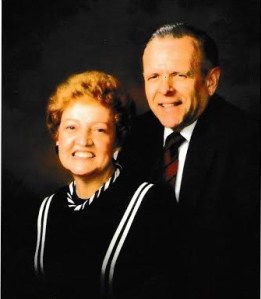 m medicine to calm him down, as a side effect it also made him sleep more. Then for a couple of nights, members from their church came to stay with him while my grandma slept. The next night, knowing that he was going to pass away soon, my grandma stayed with him. In the morning he started to breathe funny. Grandma called their oldest daughter Caren, and she came over. They sat on both sides of his bed and held his hands. He eventually stopped breathing. My grandma said there was a very peaceful feeling. They knew he was finally free from all his struggles, yet it was also very sad that he was gone. This was two years after Cathy had died.
My aunt Caren spoke at his funeral and talked about how he had left three legacies for us. First, a legacy of wonderful memories. She spoke of her memories of his wonderful speaking and singing voice before he lost it. She also spoke of her memories of how he was friendly to everyone. Second, a legacy of good humor and courage. His bishop said of him, “Paul was quick with his wit and humor to keep life sparkled with excitement and smiles. He was a man of unprecedented courage.” This influenced and inspired many. Third, a legacy of testimony of the gospel of Jesus Christ. A good friend of my grandpa’s said that he was a spiritual giant and that when he bore his testimony, there was no doubting of his conviction.
My grandpa told this same friend, “On resurrection morning when you see someone off on the horizon running, leaping and shouting at the top of his voice, that will be me.”


 Even when Cathy was in a wheelchair, she still wanted to be a part of all the activities. There was once a tomato picking service activity that she went to even though she could not pick the tomatoes. Another time, her friend Jane took her to a church dance. She took Cathy onto the dance floor and they danced. Jane pushed and spun her around to the fast beat music and accidentally tipped over the wheelchair, and Cathy spilled onto the floor. Jane felt terrible and was so embarrassed. With some help, they got Cathy back into her chair, and she exclaimed, “Lets do that again!” Good friends make life so much better.
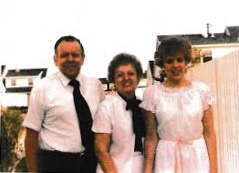
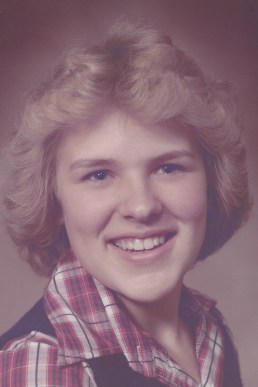

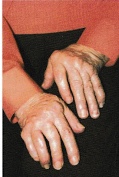 This and the loss of my grandpa’s job came within a few years of Don’s death. Grandma had to carry such heavy burdens and rheumatoid arthritis on top of it all. To me, it just seems like too much, but she faced this disease with such strength and grace. She very rarely complained and kept a positive attitude. My husband and I lived with my grandma for a few months once, and we never knew that she was in pain because she never said anything about it. Only in an occasional wince as she stood up or sat down could we see it in her eyes. To endure intense family trials while living in pain all the time and stay positive is such a remarkable feat. My grandma truly is an awe-inspiring person.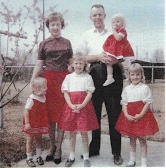


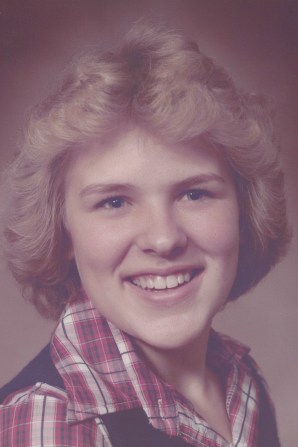 Second, my aunt Cathy, the third of the four living sisters, failed a school eye test. She was around 15 years old. They took her to an eye doctor, and just like her dad, her vision could not be helped with glasses or surgery. This was a very big shock! Cathy was beginning to have the same problems as her dad! This was not good!
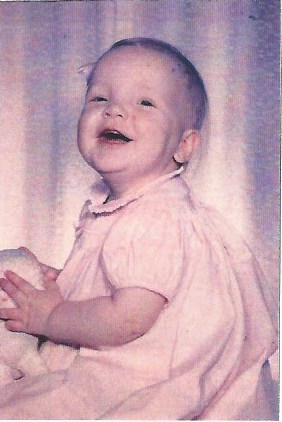 Their youngest daughter Chris was a year old. My grandma began to notice that something was not right. Chris’ physical abilities seemed to be declining. They had a baby chair that helped her to stand and walk, and she had been able to walk in this chair. Then it started to get harder for her to do it, until she couldn’t do it anymore. She also lost her ability to sit up. With these worries my grandma took Chris to the doctor. The doctor said that she was just slow developing; she was what they called a “floppy Baby.”
 that in me ye might have peace. In the world ye shall have tribulation: but be of good cheer; I have overcome the world.”
 Again, after my grandma told me Don’s story she wept. It was so sad to see this pain that my grandma will always carry with her.
 My grandpa was an amazing person. He did well in high school where he was a star basketball player and received a scholarship to the University of Wyoming. However, he declined and instead went to play for Weber State University. Later he transferred to Brigham Young University. He did well in college, but he put his schooling on hold to serve a three year LDS mission to Japan. He learned and matured much from his experiences there including the time he served as a branch president and district president. When he returned home he attended college for an additional quarter before entering the Air Force cadet program. He excelled in the Air Force. He became a Major, and he flew often. He was a good hard working man.