I was angry at God and I had to let go of that anger and trust Him. As I realized and remembered His great love for me, this was easy to do.
More to come…
I was angry at God and I had to let go of that anger and trust Him. As I realized and remembered His great love for me, this was easy to do.
More to come…
“My son, peace be unto thy soul; thine adversity and thine afflictions shall be but a small moment; and then, if thou endure it well, God shall exalt thee on high.” D&C 121:7-8

My grandparents were still living in a home in Bountiful, Utah when my grandpa retired from working for the State because of his failing abilities. As his health continued to decline, he underwent many tests and was officially diagnosed with SCA7. During this period of time, their two oldest daughters, Caren and Cindee, married and moved away. Soon after my grandparents decided to move into a condo because they couldn’t do the yard work anymore. My grandpa had hurt his back doing it, and my grandma’s arthritis make it hard for her to do. They moved to Pheasant Brooke Condos in Centerville, Utah which would be their home for the rest of my grandpa’s life.
After they moved, my grandpa got a Jazzy scooter (an electric wheelchair) for outside mobility. Going on walks outside with his walker had become slow and difficult. This scooter gave my grandpa a new-found freedom, and he loved it! He would go off on long “walks” or rides by himself.
My grandpa had a good attitude about having this disease, and he loved to joke about it. For example, one day while the family was visiting St. George, Utah, he was leaving a restaurant using his walker, and a man asked him if the food was good. My grandpa replied, “Well, when I went in I could walk and see!” Another time he had fallen and broken his hip, just days before he and my grandma were going to go on a cruise. The bishop went to the hospital to visit my grandpa, and afterwards he said that he was so impressed that my grandpa was able to joke about his situation. Also, whenever people asked him how he was doing, he would respond with, “If I was any better, I wouldn’t be able to stand it.” This upbeat and positive attitude was and is inspiring to many.
As the disease progressed and my grandpa became wheelchair bound, his greatest struggle began to manifest itself – depression. This was especially hard for my grandma to witness. He was always so happy, but now he was becoming so very sad. She took him to the doctor, and he was prescribed medicine. The medicine really helped for a little while, but then it stopped. He was then prescribed a different kind of medicine. This caused my grandpa to “ go out of his mind.” He got on his scooter and drove it out into the middle of the street. He was weaving in and out of cars. A friend, who just about hit him, hurriedly called my grandma. As my grandma rushed out of the house to go get him, he pulled up with the police. After this experience, he was very nervous to take medicine, especially this particular kind.
He was struggling with severe depression when anxiety also began to show itself. He could not stop moving and could not sleep at nights. My grandma would take him on walks in his wheelchair to help him get out of the house. Unfortunately, his anxiety made this hard too because he was so uncomfortable the entire walk. In addition it became very difficult for my grandma to reason with him. This depression and anxiety plagued him for a couple of years before the doctors finally found a medicine that began to really help.
Just before Cathy passed away, this medicine like the others stopped working. This is when he fell out of bed, and the paramedics came and took him to the hospital (see previous blogpost “Aunt Cathy”). He was at the hospital when Cathy passed away. After a day and a half he was able to go back home. Still struggling so much with depression he was unable to attend Cathy’s viewing. A friend stayed with him and then brought him to the funeral later that day.
My grandpa was having such a hard time with depression and anxiety that the doctors began to try many different kinds of medication. My grandma even put him into the psychiatric ward at LDS hospital in Salt Lake City. They had him on a high dose of antidepressants and even gave him a shock treatment. This treatment is done under anesthesia, and small electric currents are passed through the brain, causing a brief seizure. This helps to change the brain chemistry and reverse the symptoms of depression. Although, my grandma said that he never really recovered from these things. They may have helped him to feel better for a time, but the depression and anxiety only got worse as the disease progressed.
My grandpa’s worsening anxiety made it very difficult for him to sleep. He needed so much help during the night that my grandma was not getting sleep either. One day when she was at the grocery store and extremely exhausted, a friend saw her and asked how she was doing. My grandma just cried. The friend told their church bishop that my grandparents needed help. They had someone from their ward come over at nights to stay with my grandpa, so my grandma could sleep. Since this was something they would need for a long time, she decided to hire some help. A short time later my grandpa reported that when he would wake up at night, the hired help was fast asleep. So this did not work out. My grandma described this time as a nightmare. Trying to solve the problem she next took him to the sleep lab at LDS hospital. He was given some medications that helped him to sleep better.
My grandpa’s worsening depression made life miserable. He was again taken to the psychiatric ward, this time at the Veterans hospital. This ended up not working out. When his bishop came to visit him, my grandpa, still having his wit and a touch of humor, said, “Get me out of here! I can’t stand it another minute. I can’t see, so before I can eat my meals the other guys steel it. My bed slopes so bad I have to hang on to keep from rolling off. The bottoms of the drawers in the chest of drawers have all been knocked out by the poor guys before me, so there is no place to put my clothes. But to top it off, when I went to the restroom, someone had stolen the toilet paper and it took me half a day to holler loud and long enough to get a hospital worker to bring me some, so I could get out of that place. Bishop, get me out of here!” You have to remember that my grandpa had lost his voice years earlier and could only talk with a heavy whisper. He was then taken to LDS hospital’s psychiatric ward. After being there for a time, they told my grandma that there was nothing more they could do for him. My grandma took him back home. My grandpa was so miserable that he would cry out, “You have got to get somebody to help me! I cannot stand this any longer! You have got to get someone to help me!” At different times family came to be with him and to help. What a hard time.
As my grandpa’s health declined, it became very difficult for him to swallow. He would go three to four days without eating or drinking anything. My grandma would make him protein shakes, and he would get so hungry that he would all of a sudden drink one. This would bring him right back up. My grandma had hospice come to the house to help. That Christmas my grandma made her traditional slush. My grandpa always loved this slush and really wanted some of it, but he could not swallow it. He would lick some up, then spit it out. He got so dehydrated and weak that they took him to the hospital. They gave him an IV to hydrate his body and talked about putting in a feeding tube. My grandpa very sternly said he did not want one. My grandma and the doctors, taking into consideration his desires and the corresponding complications that can happen with a feeding tube, decided not to give him one.
He was brought home and given an IV to help him be more comfortable. That Sunday he asked the bishop to come give him the sacrament and a blessing. It was a sacred experience. Over this time period, he had become very weak since he hadn’t eaten food for a while. One night though he woke up and tore out his IV. The nurses then gave hi m medicine to calm him down, as a side effect it also made him sleep more. Then for a couple of nights, members from their church came to stay with him while my grandma slept. The next night, knowing that he was going to pass away soon, my grandma stayed with him. In the morning he started to breathe funny. Grandma called their oldest daughter Caren, and she came over. They sat on both sides of his bed and held his hands. He eventually stopped breathing. My grandma said there was a very peaceful feeling. They knew he was finally free from all his struggles, yet it was also very sad that he was gone. This was two years after Cathy had died.
My aunt Caren spoke at his funeral and talked about how he had left three legacies for us. First, a legacy of wonderful memories. She spoke of her memories of his wonderful speaking and singing voice before he lost it. She also spoke of her memories of how he was friendly to everyone. Second, a legacy of good humor and courage. His bishop said of him, “Paul was quick with his wit and humor to keep life sparkled with excitement and smiles. He was a man of unprecedented courage.” This influenced and inspired many. Third, a legacy of testimony of the gospel of Jesus Christ. A good friend of my grandpa’s said that he was a spiritual giant and that when he bore his testimony, there was no doubting of his conviction.
My grandpa told this same friend, “On resurrection morning when you see someone off on the horizon running, leaping and shouting at the top of his voice, that will be me.”
We have trials or hard things that happen in our lives to help us learn and grow. There is purpose in these things. It was my grandma’s belief that our trials are not just to teach ourselves, but for those around us too. To see what they will do. Will they serve and help? She said, “The one thing that has really impressed me with this disease is the people who have been so wonderful to my family, and especially my kids.” Cathy’s life was made so much more sweet and beautiful by the many who were around her, including my grandma.

My aunt Cathy started losing her eyesight in her early teens, but she started having balance problems in High School. This caused Cathy to have to face some hard times during these vulnerable and sensitive years.
Cathy was a strong-willed person with strong likes or things she LOVED. One thing she loved was singing, which she was good at. In High School she was in the choir and very much wanted to be on the Madrigals team. This group performed through song and dance. Cathy tried out, despite having slight balance problems, with high hopes of making the team. If you made the team, they would come by your house the next day, early in the morning, to take you to celebrate. They never came. She was heartbroken.
Cathy continued singing many years after High school. She took singing lessons and loved it. As the disease progressed, her singing also declined since speech is affected by it. Despite this she insisted on continuing with her singing lessons, and she practiced religiously. She was not going to let this disease take away something she loved, so easily. There came a day when her teacher said that she could no longer teach Cathy because she had too many other students. Again, this broke her heart.
In High School Cathy had many friends, even though the disease made her a little different. There were days though that she sat alone during lunch. My grandma worried about her walking to school by herself, since she had poor balance. For high school graduation she even bought herself some wedge shoes with a big heal. My grandma was amazed that she made it across the stage without falling. Cathy seemed determined to not let this disease change how she wanted to live.
Cathy decided that she wanted to go to Ricks Collage after high school. She was going to go with some of her friends, but they ended up not being able to go. She decided that she still wanted to go by herself! This would be a very scary thing to do, especially for someone who could not see the board in class. When she got to Ricks, she had someone else sign her student ID card for her because she could not see the line of where to sign. It was hard for my grandma to let her go, but she wanted her to have her independence as long as possible. I am amazed at Cathy’s courage and strong will.
Ricks Collage is in Rexburg, Idaho. This is a small town that has very cold and snowy winters. Many of the sidewalks and roads become packed down slippery snow paths, and Cathy took her wedge high heels with her! It was going to be hard for her to walk on those slippery paths, and with those shoes, it seemed impossible. Amazingly she got along until one day she fell and could not get up. She had to wait for someone to help her up. This did not discourage her. It is amazing that she got along as well as she did, especially with her classes. She got good grades. She was able to complete a year of college at Ricks.

When Cathy came home from college, she continued her university studies through home study classes. She was short only a couple of classes to graduate, but she was unable to finish because she could not see well enough to take the tests. Her strong will helped her to achieve so much despite her disabilities.
Cathy was such an amazing and capable young woman, and she was also very pretty. She always dressed well too. She loved to wear beautiful clothes. She was teased about being the best dressed in the young single adult church ward she attended. This likely explains why she wore those high healed shoes, even though it was difficult for her to walk in them.
She was able to get a job at a day care center. She loved kids. She greatly desired to marry and have many children. Here is what she said about this: “If and when I get married, I am going to the temple to be sealed for time and all eternity. Right after I get married, I want to start a family. I just love kids, and I want about 8 of them. I think life would be very unfulfilled without children. I want to be the best person that I can possibly be so that I can be the best mother that I can possibly be. So my children will have every chance in the world to rise to their potential so they can have a worthwhile life.” She loved taking care of kids, but as the disease progressed, she was no longer able to work at the day care. This job lasted for about a year.
Then the woman who cut Cathy’s hair had her babysit her kids twice a week. She was able to do this for two more years, at which point her abilities declined such that she could not do this anymore. I am sure that ability was extremely hard for her to lose. Her sister Caren said, “Her greatest desire was to be a wife and a mother, which I am sure was also her greatest sorrow.”
Although, Cathy still held on to the hope of getting married. The members of the young single adults church ward that she attended were really good to her. She made many really good friends there. Cathy very rarely missed any of the church meetings every Sunday or the other activities, of which there were many. The ward members would always pick her up and give her a ride. The boys were also very nice to her. My grandma said that whenever a boy was nice, she fell in love with him.
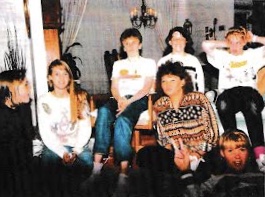 Even when Cathy was in a wheelchair, she still wanted to be a part of all the activities. There was once a tomato picking service activity that she went to even though she could not pick the tomatoes. Another time, her friend Jane took her to a church dance. She took Cathy onto the dance floor and they danced. Jane pushed and spun her around to the fast beat music and accidentally tipped over the wheelchair, and Cathy spilled onto the floor. Jane felt terrible and was so embarrassed. With some help, they got Cathy back into her chair, and she exclaimed, “Lets do that again!” Good friends make life so much better.
Like I said, Cathy had strong likes or things she LOVED, which she felt this way about many things at this point in her life. She LOVED the LDS young adult music and also the TV show “The Little House on the Prairie” She was an avid BYU and Boston Celtics fan. She even had a giant poster of Ty Detmer, a BYU football quarterback and a Heisman trophy winner, hung on her bedroom wall. She spent much of her time listening to and watching these things. Her friends once arranged for Ty to call her on her birthday! My grandma said that when he called, Cathy was so star-struck that she did not know what to say. Ty did all the talking. This made Cathy so happy!
Her friends also arranged for many of the LDS young adult singers that Cathy just adored to meet her one night for another one of her birthdays. They took her to Lex de Azevedos’ house (he did the recordings for these artists). These singers were all going to be there. When Cathy and her friends drove up to the house, one of the male singers that Cathy loved came and introduced himself. She couldn’t believe it was him. She met with all the other singers, and she was in awe the whole night. They even had a birthday cake for her. My grandma said that she talked about this forever and ever.
The disease continued to progress, and Cathy’s friends continued to make her life much more sweet and full. Cathy got to where she needed help eating. Her friends would come to her house and help feed her! I think this is amazing. Not only did she have a hard time feeding herself, but it was also getting harder to swallow properly. This caused her to choke often on her food. It was scary when this happened because she also had a hard time coughing properly. When she would choke, she would cough loud, violent and unproductive coughs. Sometimes she would even need the Heimlich or would start to vomit. During this time, a couple that was engaged came often to help Cathy. The boy was particularly concerned about her choking. Once when he was feeding her dessert, Cathy reassured him by telling him, “I never choke on dessert!” She really loved her desserts!
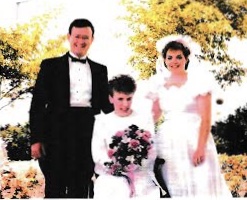
This same engaged couple was very good to Cathy. They took her many places and even made her a big part of their wedding. They knew she had a great desire to marry and would not have that opportunity in this life, so they tried to share some of their happiness with her. They had Cathy in most of their wedding photos. This was a very kind thing to do. When Cathy was in college she took a sewing class. She made a baby quilt and gave it to this girlfriend who stayed in contact with my grandma over the years. She told her that the baby quilt has been used by all her children and is very worn with love.
Another part of Cathy’s life that she felt deeply about and had a strong will to live was the gospel of Jesus Christ. She had a very strong testimony of it. She was dedicated in her callings. She served as a primary teacher for young children several times, even after she was completely blind. My grandma would read and record her lessons onto a tape recorder each week, and Cathy would listen to, memorize and then teach it on Sunday. Also, she loved General Conference. Even Fast Sundays were important to her. She would wait 24 hours – down to the minute – before she would eat. Her membership in the LDS church was very important to her.
This is what Cathy said, “I have been a member of the Church [of Jesus Christ of Latter day Saints] all of my life. The Church is the most important thing in my life. Without it I would be totally lost. What I want more than anything else is to be valiant in the gospel and to become a Christlike person, so that I can achieve my greatest goal – exaltation.”
Cathy began to struggle with depression and anxiety. She tried some antidepressants, and after a bit, they stopped working. She then tried another and the same thing happened. It got really bad. She was so anxious at night that my grandma would move all the furniture to the walls, and Cathy would scoot on her bottom around the floor, all night long. This was in the 80’s, and it was difficult to figure out the best medicine for Cathy. It was a very trying time.
She contracted pneumonia really bad. They took her to the hospital, and she was given very strong antibiotics. She was out of her mind most of the time. Everyone thought she was not going to make it. Miraculously, she survived and started to recover. Her doctor was very impressed with her. He said, “Boy, I would love to meet her on the other side because she has sure got a strong will.” He said that one time he was talking about Cathy possibly dying to the nurses while in the room, and, “She sure got wide awake and fighting when she heard me say that.” Cathy still had a will to live.
Cathy had to go into a nursing home, since she still needed a lot of care. This made her scared. Being blind and having nothing familiar around you can be a very scary thing. My grandma did not like having her there. She was still struggling with depression and anxiety so with all the drugs they were trying, again she was often not mentally present. My grandma brought her home when things stabilized some. She had to do so much for Cathy that she was not able to leave the house and was getting very little sleep. At this time my grandma was also taking care of my grandpa, whose health was also worsening. Given my grandma was having such a hard time taking care of Cathy, my grandpa and herself, she ended up taking Cathy back to the nursing home (against her desire).
Shortly after returning to the nursing home, Cathy got pneumonia again. She was already so weak from this disease that my grandma asked the doctors not to give her any antibiotics. My mom,Cindee, and Aunt Caren came to be with Cathy and to help my grandpa, so my grandma could spend more time with Cathy at the end. During this time, my grandpa fell. The paramedics came and said that he had to go to the hospital. My grandma had to go with my grandpa while they figured out what was wrong. At this same time, my mom and Caren, along with several others, were with Cathy when her heart stopped beating. They called my grandma to tell her that Cathy had died. She immediately left the hospital to say her goodbyes to Cathy at the nursing home.
Right after they called, Cathy started breathing again. She would take several breaths, then stop for a minute and then start breathing again and so on. It was like she was trying really hard to hold on. Her sisters tried to reassure her that it was OK to go, but she kept on. When my grandma arrived they told her that Cathy was still alive and holding on with what little life she had left. My grandma took her hand and hugged her. She told her it was OK for her to go and see Chris and Don and that Heavenly Father was waiting for her. Cathy then stopped breathing and she was gone.
My grandma had done so much to take care of Cathy. It was so sweet for them to have that moment together before she left.
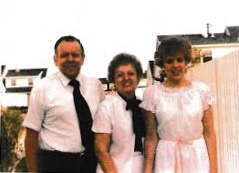
Cathy was a bright example to so many. She had great courage and did many hard things. She was so faithful to God. She had a positive attitude. When someone asked her what she felt about having this disease, she said, “Everyone has problems, this is just mine.” She was truly a beautiful woman.
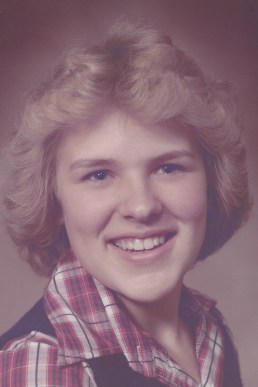
Next post: Grandpa Paul–Final Story

Sometimes life can be hard…and then it gets harder. This is the case with SCA 7. Yet, there is still joy and happiness to be had. In the Sermon on the Mount our Savior said, “Blessed are they that mourn, for they shall be comforted” (Matthew 5:4). My grandparents were comforted, and their comfort came in small and simple, yet powerful ways.
In the two years following Don’s death, my grandparents faced two more very difficult trials.
The first trial was the loss of my grandpa’s job with the Air Force. It is like he said, “The Air Force does not want pilots that cannot see and talk.” He was medically retired. My grandparents did not know how they were going to support themselves. They knew the Air Force would give them money for retirement, but they did not know if it would be enough. My grandpa was doubtful he would find another job because of his present disabilities. Moreover, his health continued to decline; his future health was uncertain. Perhaps my grandma could have gone to work, but it would have been hard. These were scary times.
The second trial was that my grandma started to suffer from rheumatoid arthritis. This affliction is when your immune system attacks your joints. It causes joint pain, swelling and stiffness along with fatigue and muscle pain. My grandma would not have another day in her life without pain. Through the years this disease caused her hands and feet to deform. 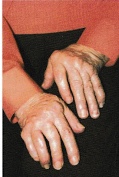 This and the loss of my grandpa’s job came within a few years of Don’s death. Grandma had to carry such heavy burdens and rheumatoid arthritis on top of it all. To me, it just seems like too much, but she faced this disease with such strength and grace. She very rarely complained and kept a positive attitude. My husband and I lived with my grandma for a few months once, and we never knew that she was in pain because she never said anything about it. Only in an occasional wince as she stood up or sat down could we see it in her eyes. To endure intense family trials while living in pain all the time and stay positive is such a remarkable feat. My grandma truly is an awe-inspiring person.
Despite all that my grandparents had to endure while living in Nebraska, they did have good memories there too. Good memories together as a family and with their friends. A part of their lives that is important to mention is their unselfish service to others. This is something they spent a lot of time doing throughout their lives, especially while living in Nebraska. My grandma obviously spent a lot of her time caring for Chris and Don along with their other children. She was also a great cook and a skilled seamstress. She sewed most of their clothes along with their Halloween costumes and Easter dresses.
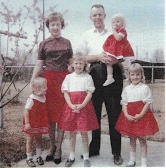


They also served a lot in their church. My grandpa had served in the Bishopric and my grandma as the Primary and then Relief Society president. Anyone that is a member of the LDS church knows that these callings take many, many hours of service. All callings in our church are completely unpaid and voluntary. One example of the time and service she gave is when she served as Relief Society president. At this time, local Relief Societies had to raise their own money. My grandma helped to organize bazaars where she and the other women would make home-made items to sell. She and my grandpa made many good friends in their ward. I mention this not to brag but to make the point that in this very hard and trying time in their lives, they had much joy and happiness in great measure because of their service to others. I feel like their service was a great comfort to their broken and heavy hearts.
They eventually had to say goodbye to all their friends in Nebraska since they decided to retire in Bountiful, Utah. Both their families lived in nearby Salt Lake City, and this is where they grew up. It was like coming home. My grandpa got a job with the State where he worked in the Department of Social Services. He was in charge of the Welfare computer systems. He was able to do this job since he had gained computer skills while working in the Air Force. He still had enough eyesight to see well enough to do this. Thankfully, they were able to support themselves, and it worked out.
However, my grandparents again had to face two more very difficult trials. The second was particularly painful!
First, my grandpa was only able to work for the Social Services department for around six years at which point his eyesight and health had become too bad. He retired, and he would not have another job for the rest of his life. Fortunately, his retirement was enough to support them.
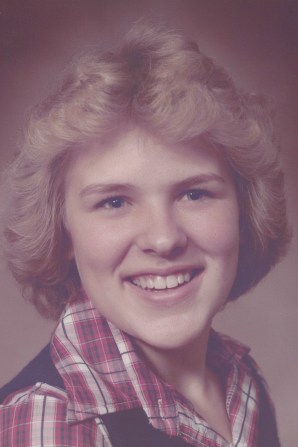 Second, my aunt Cathy, the third of the four living sisters, failed a school eye test. She was around 15 years old. They took her to an eye doctor, and just like her dad, her vision could not be helped with glasses or surgery. This was a very big shock! Cathy was beginning to have the same problems as her dad! This was not good!
They began to put the pieces of the puzzle together. They knew that my grandpa inherited this disease from his dad, but they were unsure if it was going pass onto their children. Was this what had caused the deaths of Chris and Don? Worst of all, did their other children have this disease too? Their biggest fears were beginning to happen. My grandma said that from this point on she worried all the time about her other children showing signs of this disease.
Here are her words: “Naturally I began to ask, ‘Why us?’ We just couldn’t understand why our family had to have this strange disease that nobody knew much about.”
I interviewed my grandma when I was in college, so I could record all these stores in her own words. When she said that she had asked, “Why us?”, I remember thinking, “Is that it? Shouldn’t it be more like, “How could God make my family suffer so much!?” I already knew most of these stories and what was to come. I also knew, in part, how incredibly hard it was going to get. There had been times throughout my own life when I felt so angry with God. It deeply hurt to watch my mom, aunt, cousins, and sister struggle so much from this disease. It seemed to never end, and I felt like it was way too much! But I remember being surprised at how calm and not angry my grandma was about it all. I knew that she too felt the deep heartache of seeing her family struggle, even more so than me. Yet she was not angry with God, nor did she doubt His love and care for her. To me it was like she had not doubted God throughout her entire life. It was incredible!
Despite all the hardships that defined her life, she was happy. She was anything but a grouchy old woman…although she had every right to be. She was so peaceful and calm and deeply happy. Visits with her were so pleasant, and you could feel her love for you. Her home had a spirit of peace and joy.
This is why I chose the picture at the beginning of this post. It is pouring rain, but it is not all dark and dreary. There is brightness, and it is beautiful. This is my grandma’s life.
My grandma’s example has greatly influenced me. Her uncomplaining positive attitude and undoubting faith are two qualities that I want to emulate. She has gone through so much and faced it valiantly. She found true happiness. I see such greatness in her.
My grandma passed away this month. Her grand reunion in Paradise makes me so happy. I especially love the thought of her hugging my mom, SCA 7 free! Here are her words from an interview almost a decade ago: “I look forward to the time to when I can be together with my family again and with my Heavenly Father and Savior. What a glorious day that will be!”
Next Post: Aunt Cathy
“Let your heart be not faint, Now the journey’s begun; There is One who still beckons to you. So look upward in joy, And take hold of his hand; He will lead you to heights that are new–” –Does the Journey Seem Long, Joseph Fielding Smith
I left off with my grandpa Paul’s story…he and his family were living in Nebraska, and he just permanently lost his voice. Going back a bit in time, before they moved to Nebraska, they were living in Alabama.
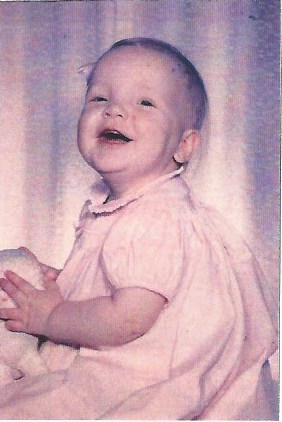 Their youngest daughter Chris was a year old. My grandma began to notice that something was not right. Chris’ physical abilities seemed to be declining. They had a baby chair that helped her to stand and walk, and she had been able to walk in this chair. Then it started to get harder for her to do it, until she couldn’t do it anymore. She also lost her ability to sit up. With these worries my grandma took Chris to the doctor. The doctor said that she was just slow developing; she was what they called a “floppy Baby.”
Shortly after this they moved to Nebraska, and my grandparents’ worries increased since Chris’ abilities were continuing to decline. They took her to a neurologist. After examining her, the doctor told them the grim news. He said that she had a neurological disease that would cause her abilities to continue to decline until death. He said that she would hold onto life for as long as she could and then maybe die of pneumonia. This was devastating news to my grandparents.
In the hallway of the doctor’s office my grandparents held Chris tightly in their arms together and wept. They never thought something as horrible as this could happen to them. It hurt so bad!
My grandparents did not realize that Chris’ neurological disease was the same as her father’s. The symptoms seemed very different and she was so young, so no connection was make.
Chris continued to decline rapidly. She started having a hard time swallowing her food. She began to loose weight until she could no longer swallow. They put a feeding tube into her stomach, and my grandma would feed her a special formula through the tube. She began to gain weight and became stronger.
She started having seizures. One time while at the doctor’s office, she had another one of her seizures, and the doctor said that her heart had stopped for a minute. Then on another day when my grandma was feeding Chris her formula, she stiffened up and began to shake. She was having a seizure again, but this time she remained unconscious when it was over. My grandma pushed on her chest, over her heart, a couple times, and she came to.
The next day she had a seizure again, and afterwards, she again remained unconscious. My grandma began pushing on her chest, but this time she wold not come to. She rushed to the neighbor who was a nurse and called 911. The ambulance came and took them to the Air Force Base hospital. Chris never came back to life in the ambulance, and she was pronounced dead when she got to the hospital. She was a couple weeks shy of being two years old.
The neighbor had called Paul, and he met them at the hospital. My grandma told him that Chris had died. He wanted to see her. He went into the room where her body lay and sat with her. This was a very difficult time.
A viewing was held at the mortuary in Bellevue, Nebraska, and then the family flew to Salt Lake City, Utah with the casket. They had another viewing at the Wasatch Lawn funeral home. A graveside service was held, and Eldred G Smith, the patriarch of The Church of Jesus Christ of Latter-Day Saints, spoke at the service. He is my great grandpa’s cousin.
When I was in collage, I interviewed my grandma about her stories from this disease. When she told me about Chris’ death, she buried her face in her hands and just sobbed. It had been over 40 years since her death, but the pain of it was still so strong. I cried with her.
Here are some of her words, “It was really hard for me to lose Chris. The Lord really did bless me. He helped me to feel peace and to feel better about her death. He helped me to go on.”
“These things I have spoken unto you, that in me ye might have peace. In the world ye shall have tribulation: but be of good cheer; I have overcome the world.”
John 16:33
After Chris’ death, my grandparents had their sixth child. It was a boy! After five girls, this was a very big deal! My overjoyed grandpa called his daughters on the phone and enthusiastically told them the news. In all of the excitement, a nurse asked my grandpa if Don was their first child.”No, he is just our first boy!”

My grandpa was especially thrilled to have a son. Behind their home there was a football field. He would take Don into the backyard, and they would watch the games together. Not only was he highly adored, but he was a beautiful baby too. A friend at church told my grandma that Don was the most beautiful baby she had ever seen. My grandma said that just like Chris, Don was such a sweet baby-a sweet little angel.
His six week check up is when my grandparents began to see his decline. After loosing Chris this was particularly poignant. And just like with Chris, they would initially not make the connection that this was the same disease. First the doctor discovered that he was blind. My grandma had noticed that there was something wrong with his eyesight because his eyes never focused on things. However, what worried the doctor the most was his heart. A valve did not shut off completely at birth. This was causing some other problems too. The doctor said that sometimes this problem corrects itself as the child grows. This was hopeful news.
Thanksgiving was coming up, and my grandparents had planned a family trip to Salt Lake City to spend the holiday with their families. As they were driving, Don started having problems breathing. He cried and cried and cried. At Colorado Springs they took him to the Air Force Academy Hospital where they stayed the night. He was having serious heart problems. The doctors there told them that the doctors in Salt Lake City were very good, so they should just keep driving.
They anxiously drove and prayed the entire time that Don would make it! They arrived, and my grandpa rushed Don to Primary Children’s Hospital. They immediately operated on his heart and fixed the valve that had not closed. By this time his heart had enlarged, since it had to do so much extra work. They kept him in the intensive care unit while he recovered. The nurses all called him “handsome.”
My grandpa had to go back to work and the girls had school, so they all went back home except for my grandma and their youngest daughter Carolyn who stayed with Don. They stayed with my grandma’s mother who lived there in town. Don was released from intensive care, but he was still not doing too well. He was in and out of the hospital. He was having a hard time breathing. After a month, they decided it was time to go back home. They got tickets to ride the train back to Nebraska. My grandma’s mother went with them. They worried about Don the entire trip. This must have been an especially hard and anxious time for my grandma.
Don was having problems as soon as they got home, so they rushed him to the Air Force Base Hospital. He was put on oxygen, but he continued to decline. At one point he had stopped breathing, and they had to revive him. He would never leave a hospital for the rest of his life. On a Sunday afternoon my grandma went to be with Don while the rest of the family went to church. As she sat with him, she knew he was dying and was not getting better. She could’t even get him to respond anymore. Later, my grandpa walked into the room, and she told him this. My grandpa desperately told the nurse that Don needed more help!
They called a Doctor from the University of Omaha Hospital, and Don was transferred there. He was getting more help at this hospital, but there was little they could do. My grandparents sensed that they were losing Don, and they tried to be with him as much as possible. They had work and their girls to care for, so they couldn’t be with him as much as they would have liked.
This was an especially hard time for my grandpa. He adored his son. Despite these hard circumstances, his spirit remained bright and full of faith. He would go to visit Don on his lunch breaks. A friend had gone to the hospital during one of my grandpa’s visits. He said that he went to help and comfort my grandpa, and instead my grandpa cheered him up. Another time at church my grandpa bore a powerful testimony. Those who knew him knew he was bearing his testimony to Don. It was such a powerful testimony that their friends remembered it many years later.
Don continued to decline. They were unable to hold him because of his oxygen, so they would pat and rub his arms and head. He was not eating much. One evening after returning home from the hospital, they got a call that they needed to come back. Just after they retuned, Don passed away. He was 6 months old.
The family (along with Don’s body) flew to Salt Lake City for a viewing and graveside service. He was buried next to his sister Chris. Eldred G. Smith also spoke at Don’s service. They were buried at the Wasatch Memorial Cemetery.
 Again, after my grandma told me Don’s story she wept. It was so sad to see this pain that my grandma will always carry with her.
Here are her words: “Paul and I were blessed. The Lord blessed us with a peace of mind. We always had a strong testimony of the Plan of Salvation. It was sad to lose Chris and Don, but we knew we would see them again and be with them again as a family. It strengthened our testimonies to have this happen to us. I am thankful for these experinces.”
Chris and Don definitely had a large impact on their four older sisters, although they were young. At Don’s viewing, my mom, Cindee, cried and cried while she looked at her baby brother’s body. The faith of their parents really helped them. My grandma said that they knew Chris and Don were with their Heavenly Father and that they were wonderfully happy. With this eternal perspective, they knew everything was going to be ok.
Along with her sisters, my mom kept this eternal perspective throughout her life. It definitely helped her as she continued to face the trials of this disease. This eternal perspective was so strong in my mom, and has greatly influenced me! It has helped me to realize that it is not so much about the things that happen to us in this life than it is about preparing for the next.
I am very grateful for the knowledge that Chris and Don are wonderfully happy and they are now reunited with most of their family. I wish I could see the joyous reunion that is still to come with their oldest sister Caren and with their beloved mother! What a sight that will be!
Next post: When It Rains, It Pours!
My kids are back in school, so now I have time to write again.
I would like to start at the beginning.
Like I said, for me and my story it all begins with my Grandpa Paul. He was 34 years old, and life was pretty much perfect. He knew nothing about SCA7 and that it was in his family. His father Clifton had it, but he was never diagnosed. Clifton started showing signs of the disease at an older age, so it progressed very slowly and was confused with aging. Also,my grandpa’s only sibling had not begun to show any signs or symptoms of the disease at this point in her life. So he was completly oblivious to the fact that he had SCA7 and the great destruction it was going to cause.
 My grandpa was an amazing person. He did well in high school where he was a star basketball player and received a scholarship to the University of Wyoming. However, he declined and instead went to play for Weber State University. Later he transferred to Brigham Young University. He did well in college, but he put his schooling on hold to serve a three year LDS mission to Japan. He learned and matured much from his experiences there including the time he served as a branch president and district president. When he returned home he attended college for an additional quarter before entering the Air Force cadet program. He excelled in the Air Force. He became a Major, and he flew often. He was a good hard working man.
These are all great accomplishments, but the greatest of them all began ten years earlier when he met and married my wonderful grandma, Ida Marlene. Shortly after being married, they started a family together, and by the time he was 34 they had five beautiful and healthy daughters: Caren, Cindee (my mom), Cathy, Carolyn and Chris.
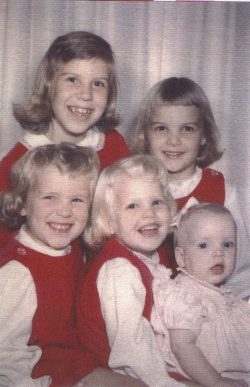
He was a very good husband and father. They were a happy family; no they were not perfect-no family is-but they were happy.
Because my grandpa was in the Air Force, he and his family lived in many different places. At this time, they were living in Montgomery, Alabama where my grandpa was attending Command and Staff school. This is when he first began to notice his eyesight going bad. He was having a hard time seeing the board in his classes. Unfortunately, his bad eyesight could not be fixed with glasses and continued to worsen. In addition he started to notice problems with his balance.
Obviously eyesight is a big deal for pilots, so the Air Force sent my grandpa to the main Armed Forces medical base, Wright-Patterson, to be further examined. Many tests were done until he was diagnosed with a neurodegenerative disease called Ataxia. According to the doctors, Ataxia only explained the balance problems, not the loss of eyesight. This remained a mystery. My grandpa did realize that the Ataxia was likely passed onto him from his father. He remembered his dad having balance problems just like he was now experiencing.
My grandpa then got transferred to Omaha, Nebraska where he was given an office job and would fly very little. This was a huge disappointment to him. He LOVED flying.
While in Nebraska, he was called into the leadership of an LDS congregation where his family attended (i.e. counselor in the bishopric). During that time their congregation (“ward”) learned the great news that a new church building had been approved to be built for them. In those days members were asked to fund the construction of their chapels. As part of the bishopric, my grandpa met with members to ask if they would be willing to donate money and how much. One day, he met with members for an entire Sunday, and when he came home late and tired that night, he had lost his voice and could only whisper. He never got his voice back and spoke with a whisper for the rest of his life.
SCA7 does cause a certain part of your throat and tongue to gradually decrease in control. Slurred speech, trouble coughing and easily choking while eating food all happen as a result. My grandpa only being able to whisper from this point on surely was linked to the disease, but he is the only member in my family to experience this particular disability.
This is just the tip of the iceberg though. Deep tragedy is just ahead and will continue on and on and on… There are two things that will buoy them up and leave them standing with their hearts full of love: their faith in Jesus Christ and family.

It is amazing to me how much parents can impact their posterity for generations! Yes, I inherited SCA7 from my grandpa, but I am richly blessed by his great faith and for all he did to build a strong and happy family. I do not know why God blessed me so much by placing me among the posterity of my Grandparents, I definitely did not deserve it. I am just very grateful for the grand legacy they have left me!
Next post: Chris and Don
My sister and I have gone through a lot in trying to prevent our children from inheriting SCA-7. What we went through was hard, but I would whole-heartedly say it was worth it!
We have been extremely fortunate to have had the help of our parents in this matter. Before my sister and I were even married, my dad had done a lot of research on ways we could have children without passing our disease on to them. Through his research he found out about PGD (preimplantation genetic diagnosis). This is done as part of an IVF (in-vitro fertilization) cycle. Together these procedures are expensive (approximately $20,000). My parents foresaw that if my sister and I were ever to marry, we would most likely not have the money to pay for something this expensive, this early on in our lives. So they saved enough money to help finance this for the both of us. Later, when I became engaged to be married, my parents shared all this information, and generously offered to assist us financially, if this was something we chose to do.
I found out that I had this disease a couple of months before I got married. I knew that if I wanted to have children, I would have to have them as soon as possible. My health and abilities were only going to get worse the longer I waited. My husband and I really wanted a family with children. If my parents had not done all this work to help prepare a path for me to have children through IVF/PGD, I most likely would not have been able to have as many children as I do, four, without this disease. I am so deeply grateful for this. Thank you, thank you, thank you!
Also, I want to thank my oldest brother Josh, who also helped to finance an IVF/PGD cycle for both my sister and I through the company he worked for, Vivint. My other two brothers, along with others helped out through Vivint, too. Thanks!
Now I will explain in more depth what IVF/PGD is.
IVF (in-vitro fertilization) is the process of taking eggs from the mother and fertilizing them with sperm from the father to create embryos, the beginning form of human life. This is all done outside of the body. The embryo(s) are then implanted into the mother’s uterus to hopefully result in pregnancy. Extra embryos, not used immediately, can be frozen and saved for later use.
PGD (preimplantation genetic diagnosis) is as the name denotes. Before the embryos are implanted into the mothers uterus, a single cell or two is biopsied off an embryo after it has grown to be around 8 cells big. This does not harm the embryo. The biopsied cells are then genetically tested to determine if they have SCA7, or whatever disease is being tested for. The disease-free embryos are implanted into the mother. The PGD clinics that I am familiar with will only test for life threatening diseases.
When we learned about PGD, we were highly concerned about what was done with the embryos that had SCA7. The answer to this concern is that they are allowed to die. Embryos are unable to live long outside of the womb. Since they are not put into the womb, they quickly die. This is something that was very concerning to me and my family. We would essentially be allowing this destruction of life.
All would agree that the destruction or killing of human life it a most serious matter! I believe there are great consequences to these actions that extend beyond this life. So it was very important to me to find out how God felt about my situation. My husband and I along with the rest of my family felt that us doing PGD was the right thing. We even felt that God had a hand in helping in the development of PGD. He had helped to provide a way for us to stop this disease from passing onto our children. What a wonderful gift from a loving Heavenly Father and an answer to many prayers!
My sister Aubree wrote down her experiences in doing IVF/PGD for me to share. In her story it will become more clear as to how it all works.
My IVF/PGD Tale–by Aubree
Taylor and I began IVF/PGD shortly after we were married. We were living with Taylor’s mom, Kathy, while he was starting his career in teaching. He was taking night classes and during the day took substitute teaching jobs, which was very sporadic and unreliable. During this time he did not get many subbing jobs, which was actually a good thing since he was able to take me to my many IVF appointments.
We met with a fertility doctor at a nearby hospital and we began the process. Taylor was taught how to play doctor so he could give me shots, lots of them!
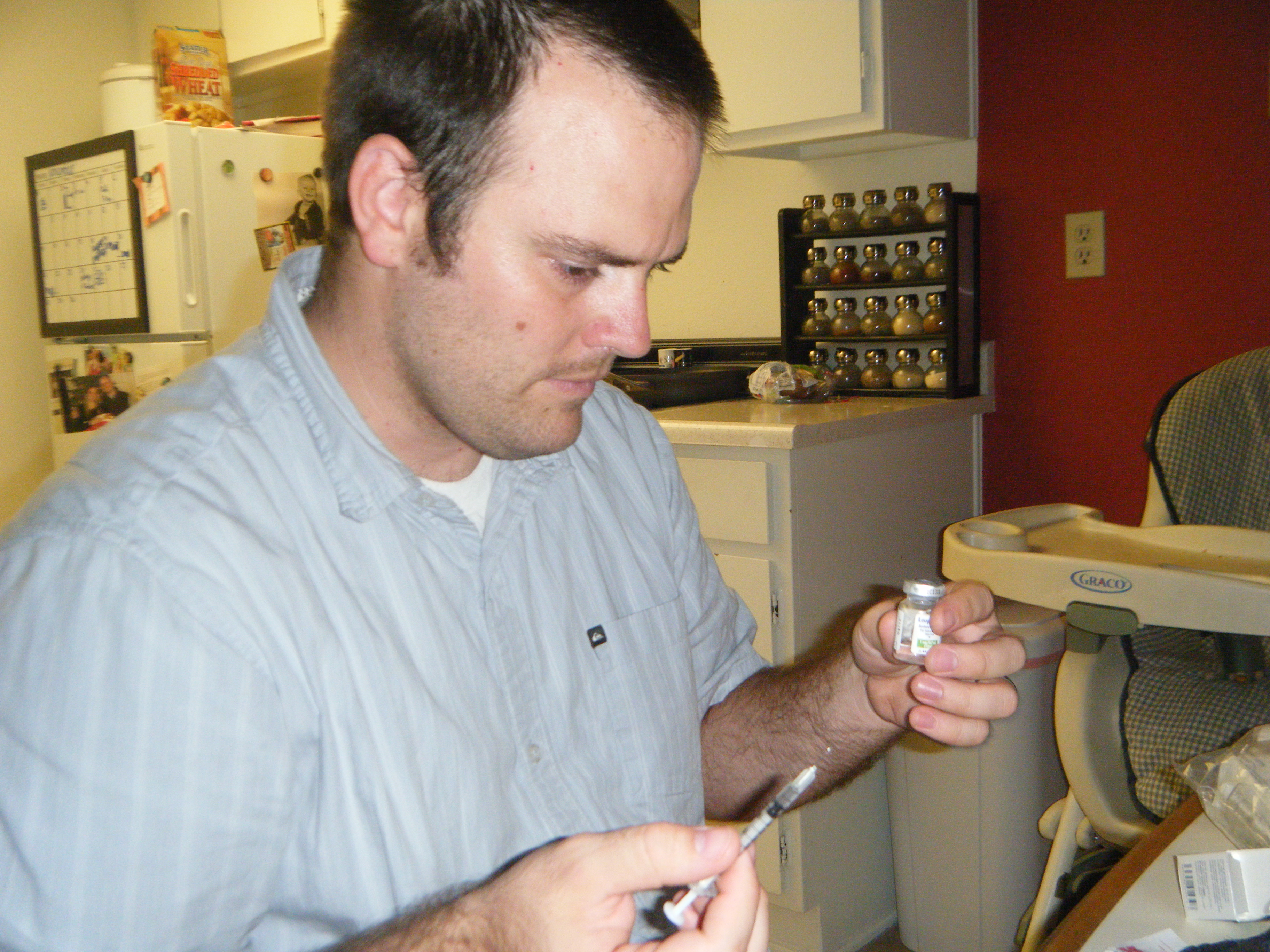
First he gave me shots of FSH, estrogen, and LH in the belly twice daily for about two to three weeks This helped me to produce an abnormally large amount of eggs in my ovaries. A woman will normally produce only one egg a month. I also had frequent visits where the nurses would poke my arm to death trying to get a blood sample. This was so they could make sure my hormone levels were good and high, yet safe. The egg production in mu ovaries was also checked often. Through all of this I felt like a pin cushion, highly emotion and overly blotted. Thankfully, my mother-in-law kept a constant supply of ice cream in the freezer!
When the time came for the retrieval of my eggs, they were able to remove 25. The doctors worked quickly to fertilized my eggs, which resulted in only 10 embryos. My embryos were allowed to grow for three days where they were about 8 cells big. During this time a few of my embryos had stopped growing and had died. A single cell was biopsied off of each of the living embryos then labeled, packaged and shipped to Michigan. This is where Dr. Hughes and his team worked hard to genetically test each of these cells to determine which embryos had SCA7 and those that did not, PGD. All of this has to be done in two days, when the embryos reach 5 days old, since they cannot live much longer than this outside of the womb. Again, a few of my embryos had died. When we got the results back from Michigan, I only had two living embryos without SCA7 left. They were both immediately implanted inside me.
Taylor then started to give ma a thick, oil based, progesterone shot in the bum every evening for up to four weeks, ouch! This helped my body to prepare for pregnancy. Unfortunately, 12 days later I found out I wasn’t pregnant. I was utterly devastated. Although, the same day we also got some really good news. Taylor was offered a long-term subbing job teaching the same class until the end of the semester. This was going to be a great opportunity for Taylor’s career and would help us financially too. We really needed this break. This helped to reassure me that the Lord was still helping us out, even though I was not pregnant.
I decided to spend the next couple months recuperating from this very emotionally and physically trying experience. After many prayers, we decided to try it again, but with a different IVF doctor. After doing our research, we found a highly recommended fertility clinic. We met with Dr. Lin and got started with the shots right away. We had such a better experience this time. Dr. Lin was super friendly and the nurses were awesome! We were so happy we made this change.
This time they retrieved the same number of eggs, 25. They were fertilized and 16 embryos formed! After the biopsy and shipping to Michigan for PGD, we were left with 5 SCA7-free embryos. We implanted two and froze the other three, for later use. On February 9th, our wedding anniversary and my mom’s birthday, we found out I was pregnant! It was so fun to call my mom to wish her a happy birthday by giving her this most wonderful news.We were all so happy!
I had an ultrasound to make sure all was going well and we found out I was pregnant with twins! We were so excited! Everything was going well until one day I started bleeding pretty bad. We went in for another ultrasound and were so relieved to see that we still had a baby that had a strong and healthy heartbeat. Our other baby had died. Dr. Lin was so happy and excited with how well baby A was progressing that it was hard to be sad about baby B. It was a bitter-sweet day. This all happened early on in my pregnancy.
We later found out that our baby was a boy. He came 3 weeks early and I was only in the hospital for 4 hours to when we first heard him cry. Taylor whispered to me, “That’s OUR baby!” and I was overcome with joy and love! The day and night I spent in the hospital with my precious little bundle of cuteness was glorious. I was on could nine.

When my baby boy was a year old we decided it was time to try it again with our three frozen embryos. This was a much simpler process since we had embryos that were all ready to go. Our embryos were defrosted and only two survived. They were implanted and we waited and hoped for a couple of weeks until I could take a pregnancy test. I want in for the blood draw and waited for the results. They were negative. I was not pregnant.
When I found out the news, over the phone, I started crying, and my sweet baby boy gave me a big hug and while kissing me said, “I wav you.” I am SO lucky to have the family I have! They lift me up every time I feel down. Perfect love casteth out all fear. – 1 John 4:18

Thanks Aubree for sharing your story.
My sister is the best mom. There is a lot of love in her family.
I will share my stories about doing IVF/PGD in a later post.
I want to end by saying that my life has been richly blessed. Yes, I am scared and terrified at times for what the future holds for me in terms of this disease. But I am more excited than scared because of my family and the life we will have together. Again, I am so richly blessed!
Please feel free to ask me any questions you may have about PGD.
This is my favorite picture of my mom.
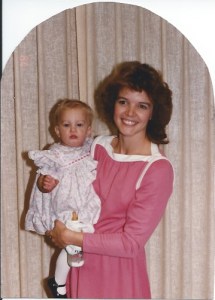
In this picture I am around a year old, and this is also when my mom first started to notice that her eyesight was beginning to go bad. This really scared her because in our family bad eyesight could mean you need to get a pair of glasses or you have the disease(SCA7). Bad eyesight is the first noticeable sign of having this disease. If the eye doctor tells someone in my family that glasses cannot correct their bad vision, then it is almost guaranteed that they have the disease. The doctor told my mom that glasses could not help her. This news completely devastated her and my dad.
SCA7 (Spinocerebellar Ataxia Type 7) is a progressive neurodegenerative disease. This means that certain brain cells continue to die until it causes the death of the individual. In SCA7, this cell deterioration also happens in the eyes. The only area of the brain that is affected is where motor functions are controlled. As the disease progresses a person with SCA7 will start to become less balanced and coordinated in all their movements. In their walking they will begin to stagger, and then they will need assistance with something like a cane, then walker, until eventually a wheelchair is needed. Eyesight is also lost until complete blindness occurs. These abilities will decline until it causes death.
Here is a video of my younger sister Aubree walking with her walker. When I first asked her for a video of her walking, to help me better explain this disease for this blog, she was hesitant to do so. She does not want people to feel sorry for her or think that she does not have a good, livable life. Also, she does not like people to label her as handicapped. Usually when we see people physically handicapped, mental handicaps often are present. This is NOT the case with SCA7. My sister is very much mentally capable! Also, she is a very beautiful person whose talents and capabilities would amaze you despite her physical limitations. She has been helping me with the pictures and videos on this blog. She even put together the picture at the beginning which shows everyone in our family affected by the disease. She does have bad vision but can see well enough to create great things on the computer. She is such a fun-loving and awesome person to get to know.
When I first saw this video, it made my heart ache so bad! I live far away from my sister and am only able to see her a couple of times a year. The last time I saw her, she was able to walk better than this. She now has started to primarily use a wheelchair since walking has become so difficult. It is extremely hard to watch my sister go through this disease!!
Ok, back to explaining.
This disease is inherited from one’s parents and can be passed onto one’s children. There is a 50% chance of passing it on. My grandpa Paul and grandma Marlene had six children. Only their oldest child, Caren, did not inherit SCA7, so their ratio was 5/6. Much worse than 50%. Then their daughter, my aunt Carolyn, and her husband, Scott, had two children, Callie and Lance. They both inherited the disease, so their ratio was 2/2. The worst possible! The ratio in my immediate family is less than 50%. I have three older brothers who did not inherit this disease, whereas my sister and I did. Our ratio is 2/5. If you do not inherit this disease, then there is no way to pass it on. This is a wonderful thing. So unfortunately, in my grandpa Paul’s branch of the family, most of the children born to a parent with SCA7, inherited the disease.
My sister and I both have children. We have been able to stop our children from inheriting SCA7 through a process called Preimplantation Genetic Diagnosis (PGD) which is done as part of an in vitro fertilization (IVF) procedure. I will explain this in greater detail in a later post.
This disease progresses very slowly. I would compare it to a child growing. It is not noticeable on a daily or weekly basis, but from year to year you can more clearly see its progression. The rate of progression depends upon how severely a person has this disease. The less severe, the older the age of onset and the more slowly it progresses. The more severe, the younger the age of onset and the more rapidly it progresses. For example, my grandpa Paul’s age of onset was around 35, and the disease progressed very slowly for another 28 years until he passed away at age 63. My cousin Lance’s age of onset was 10, and the disease progressed more rapidly for 9 years until he passed away at age 19. Also, my aunt Chris and uncle Don passed away at very young ages because they had the disease so severely. Don was able to live only 6 months and Chris only 2 years.
What this disease does to a person is pretty devastating, but it is not so horrible throughout the life span of the disease. As I already explained, this disease progresses slowly. To better explain this I will separate the life span of this disease into three stages.
I will define the first stage from the time eyesight begins to decline to when walking without assistance is no longer possible. This is the stage that I am in. For me this disease has progressed very slowly. I started noticing a decline in my eyesight almost 10 years ago. I gave up my driver’s license around 7 years ago. Not being able to drive has been one of the hardest things I have had to deal with to date. Although, I have been very fortunate to be surrounded by people that are very willing to drive me places. My eyesight has become pretty bad. I have to hold things close to my eyes to see them clearly, yet I can still see so much! I am no longer able to run without assistance, and when I walk, I am slow and have begun to occasionally stagger. I think it may look like I am drunk. For balance I often hold onto my husband’s arm whenever he is beside me. From an outward appearance my disabilities are not very noticeable. Life up to this point with SCA7 has not been too difficult. The disabilities that I deal with still seem very small compared to what is coming.
I will define the second stage of this disease from the point at which a walker or assistance is required to walk to the point at which you cannot use an electric wheelchair. During this stage the disease becomes more obvious to those around you. Daily tasks and getting around become more difficult and frustrating. You are still able to see, but eyesight continues to get worse. Social situations become hard. This is when the disease becomes a much bigger part of moment-by-moment life.
I found this picture of my mom using her electric wheelchair. My mom had fallen a couple of times while using her walker, so it was decided that it was time to move to a wheelchair. This was a very depressing step for my mom, since she was going to lose some of her mobility. My dad did some research, and he found this Jazzy (electric wheelchair) for my mom. She loved it! It actually gave her even more freedoms than she had had with her walker.

At this time I was in high school. Even though my mom had all these disabilities, she was still a very capable person. In the morning she would wake up with us, make the family breakfast before school, and pack us all a lunch. Then she would make the family dinner every might. My mom was in a wheelchair, and she made me and my family all three meals! She also worked hard to take care of our house. With five kids our house was hard to keep clean, but my mom did a pretty good job. She took a lot of pride in her ability to take care of her family. It was hard to see her struggle as these abilities were taken away.
The third and last stage I will define from the time a non-electric wheelchair must be used (because eyesight is too limited to drive) to the time of death. In this stage things become extremely difficult. Abilities to perform household chores like cooking and cleaning are lost. The speech becomes slurred, and choking while eating happens frequently. Also during this stage eyesight become very limited until blindness occurs. For our family, depression becomes severe, and towards the end anxiety increases to the point of severe panic attics. Additionally, the body becomes stiff and hard to move. Assistance becomes necessary for most everything: eating, bathing, using bathroom, etc. This stage scares me!
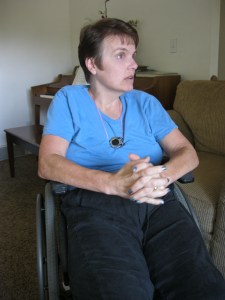
This is a picture I took of my mom a couple of years before she passed away. At this point my mom was struggling with everything I just described. It was difficult to understand her slurred speech, but as her daughter I could still understand her. She spent a lot of time in bed, and many times I would sit next to her to talk with her. Yes, she had an extremely large dose of hard and discouraging times. I remember once she told me that at her funeral she wanted a disco ball and dancing. She wanted everyone to celebrate with a grand party because she was finally freed from her crippled body! You should know that my mom had quite the sense of humor. As I watched my mom live through it all, I was so amazed and awed by her strength. Her gratitude was inspiring. When she was discouraged, which was often, she would count her blessings. She was truly grateful for the few things she could still do. She had such great faith, hope and love. I know the Lord was with her. I love you mom. Happy Mothers Day!
I want to end this post with a video of my cousin Callie. It gives you a good sense of how the disease affected her. She passed away a year and a half after the filming of this video. Just a little info about Callie. She is THE sweetest, most pure, and most fun person to be around that I have ever met. I loved all the time that I spent with her. I am sure that everyone who knew Callie will agree that the time they spent with her made them a better person. Memories of her make me smile real big. I love you Callie!
Next Post: Grandpa Paul Canfield
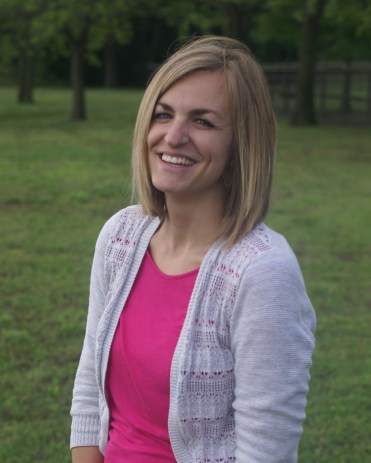
Hi, I’m Mandee and I have a disease called SCA7 and I have a story to tell! Actually, I have lots and lots of stories to tell. SO many that it will take me years to tell them all. I want these stories told here on this blog for two reasons. First, so I can record them. Second, so I can share them.
The stories I want to share are all related to SCA7 (Spino Cellabellar Ataxia Type7). This disease is very unique. In fact, it is called an orphan disease because very few people have it. It is also unique because of the way it dramatically affects not just one person but many family members for generations.
These stories will not just be about me but also about my other family members that have SCA7 too. This disease is genetic, meaning that it is in your genes and therefore can be passed onto one’s children. There is a fifty percent chance of passing it on. The picture below shows those of us from my family, starting with my grandpa Paul and progressing from there, who have inherited SCA7. There are 10 of us, and all have already passed away from this disease except for my younger sister and me. Because of modern medicine and advancements, we have been able to stop the passing of this disease onto the next generation. So this means, in our branch of the family, my sister and I are the last ones.
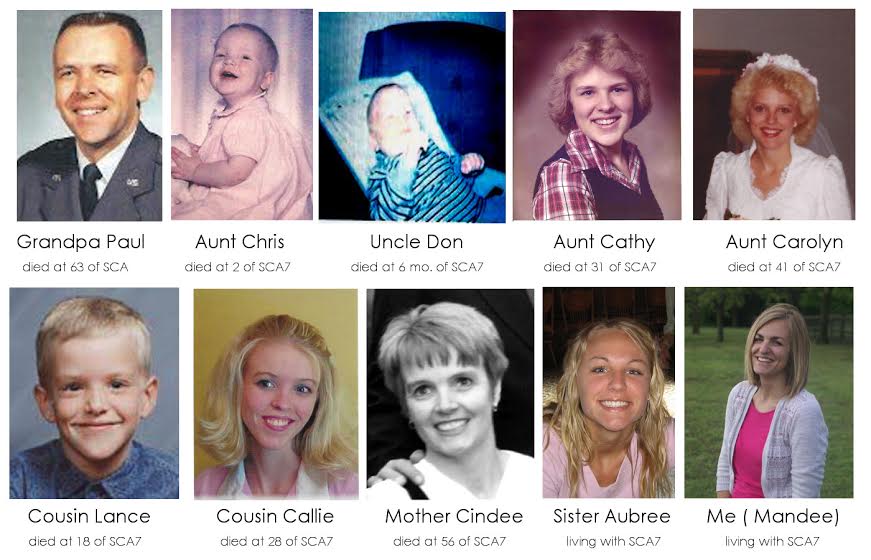
As far as I know, this disease does go back from my grandpa Paul to his father and grandfather. Which means that I do have distant relatives with SCA7. But for me and my story, it all starts with my grandpa Paul. I knew my grandpa well, along with those in the above picture. We are a close family, and we have done a lot together throughout my life, except for my Aunt Chris and Uncle Don who passed away at very young ages. Although, I was told many stories about them and their deaths by my mom and grandma. They hold a very special place in our family.
I feel an extra special bond with each of these family members. I treasure their examples and life stories. They give me strength and hope that even a life with SCA7 can still be really good. Their lives were full of great people, family, love, hope and faith. I think of them a lot and feel like they are around me at times, like they are my guardian angels. I also feel like they want me to share their stories.
It is difficult for me to put into words the effect that this disease has had on my life. I would use words like huge, dramatic and life changing. It has caused my soul to feel so much pain, anguish, fear and frustration, and it has broken my heart over and over again. It has played a large part in what has shaped me into the person I am today. Yet, through these experiences, I have learned some really valuable lessons. One of the many great blessings this life has to offer is knowledge. The world we live in has become very confusing as to what is truly good and right or truly bad and wrong. It is interesting how loosing abilities like walking, coordination and eyesight along with suffering and death can help to bring into better focus what things bring lasting and real happiness, peace and joy.
The greatest blessing I have found through the experiences from this disease and seeing the examples of those before me is greater faith — faith in God and in His son Jesus Christ and faith that they love us so very much. We can trust them! This great truth that I have come to more fully know is the most valuable thing I possess. I am so grateful for the experiences and examples that I have had and seen that have strengthened my faith. Even though these experiences were and are hard, very hard, to go through, and worse…to see others that I love go through, it just increases my hope for that better place that has been promised us by the Lord.
So are you ready to hear some stories?
Well, first I need to explain what exactly SCA7 is and what it does to a person.
Coming very soon…stay tuned.
Next post: What Is SCA7?


 SCA7 Through My Eyes