This is my favorite picture of my mom.
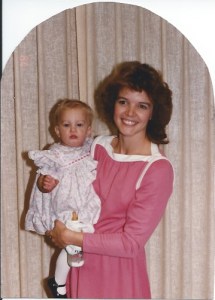
In this picture I am around a year old, and this is also when my mom first started to notice that her eyesight was beginning to go bad. This really scared her because in our family bad eyesight could mean you need to get a pair of glasses or you have the disease(SCA7). Bad eyesight is the first noticeable sign of having this disease. If the eye doctor tells someone in my family that glasses cannot correct their bad vision, then it is almost guaranteed that they have the disease. The doctor told my mom that glasses could not help her. This news completely devastated her and my dad.
SCA7 (Spinocerebellar Ataxia Type 7) is a progressive neurodegenerative disease. This means that certain brain cells continue to die until it causes the death of the individual. In SCA7, this cell deterioration also happens in the eyes. The only area of the brain that is affected is where motor functions are controlled. As the disease progresses a person with SCA7 will start to become less balanced and coordinated in all their movements. In their walking they will begin to stagger, and then they will need assistance with something like a cane, then walker, until eventually a wheelchair is needed. Eyesight is also lost until complete blindness occurs. These abilities will decline until it causes death.
Here is a video of my younger sister Aubree walking with her walker. When I first asked her for a video of her walking, to help me better explain this disease for this blog, she was hesitant to do so. She does not want people to feel sorry for her or think that she does not have a good, livable life. Also, she does not like people to label her as handicapped. Usually when we see people physically handicapped, mental handicaps often are present. This is NOT the case with SCA7. My sister is very much mentally capable! Also, she is a very beautiful person whose talents and capabilities would amaze you despite her physical limitations. She has been helping me with the pictures and videos on this blog. She even put together the picture at the beginning which shows everyone in our family affected by the disease. She does have bad vision but can see well enough to create great things on the computer. She is such a fun-loving and awesome person to get to know.
When I first saw this video, it made my heart ache so bad! I live far away from my sister and am only able to see her a couple of times a year. The last time I saw her, she was able to walk better than this. She now has started to primarily use a wheelchair since walking has become so difficult. It is extremely hard to watch my sister go through this disease!!
Ok, back to explaining.
This disease is inherited from one’s parents and can be passed onto one’s children. There is a 50% chance of passing it on. My grandpa Paul and grandma Marlene had six children. Only their oldest child, Caren, did not inherit SCA7, so their ratio was 5/6. Much worse than 50%. Then their daughter, my aunt Carolyn, and her husband, Scott, had two children, Callie and Lance. They both inherited the disease, so their ratio was 2/2. The worst possible! The ratio in my immediate family is less than 50%. I have three older brothers who did not inherit this disease, whereas my sister and I did. Our ratio is 2/5. If you do not inherit this disease, then there is no way to pass it on. This is a wonderful thing. So unfortunately, in my grandpa Paul’s branch of the family, most of the children born to a parent with SCA7, inherited the disease.
My sister and I both have children. We have been able to stop our children from inheriting SCA7 through a process called Preimplantation Genetic Diagnosis (PGD) which is done as part of an in vitro fertilization (IVF) procedure. I will explain this in greater detail in a later post.
This disease progresses very slowly. I would compare it to a child growing. It is not noticeable on a daily or weekly basis, but from year to year you can more clearly see its progression. The rate of progression depends upon how severely a person has this disease. The less severe, the older the age of onset and the more slowly it progresses. The more severe, the younger the age of onset and the more rapidly it progresses. For example, my grandpa Paul’s age of onset was around 35, and the disease progressed very slowly for another 28 years until he passed away at age 63. My cousin Lance’s age of onset was 10, and the disease progressed more rapidly for 9 years until he passed away at age 19. Also, my aunt Chris and uncle Don passed away at very young ages because they had the disease so severely. Don was able to live only 6 months and Chris only 2 years.
What this disease does to a person is pretty devastating, but it is not so horrible throughout the life span of the disease. As I already explained, this disease progresses slowly. To better explain this I will separate the life span of this disease into three stages.
I will define the first stage from the time eyesight begins to decline to when walking without assistance is no longer possible. This is the stage that I am in. For me this disease has progressed very slowly. I started noticing a decline in my eyesight almost 10 years ago. I gave up my driver’s license around 7 years ago. Not being able to drive has been one of the hardest things I have had to deal with to date. Although, I have been very fortunate to be surrounded by people that are very willing to drive me places. My eyesight has become pretty bad. I have to hold things close to my eyes to see them clearly, yet I can still see so much! I am no longer able to run without assistance, and when I walk, I am slow and have begun to occasionally stagger. I think it may look like I am drunk. For balance I often hold onto my husband’s arm whenever he is beside me. From an outward appearance my disabilities are not very noticeable. Life up to this point with SCA7 has not been too difficult. The disabilities that I deal with still seem very small compared to what is coming.
I will define the second stage of this disease from the point at which a walker or assistance is required to walk to the point at which you cannot use an electric wheelchair. During this stage the disease becomes more obvious to those around you. Daily tasks and getting around become more difficult and frustrating. You are still able to see, but eyesight continues to get worse. Social situations become hard. This is when the disease becomes a much bigger part of moment-by-moment life.
I found this picture of my mom using her electric wheelchair. My mom had fallen a couple of times while using her walker, so it was decided that it was time to move to a wheelchair. This was a very depressing step for my mom, since she was going to lose some of her mobility. My dad did some research, and he found this Jazzy (electric wheelchair) for my mom. She loved it! It actually gave her even more freedoms than she had had with her walker.

At this time I was in high school. Even though my mom had all these disabilities, she was still a very capable person. In the morning she would wake up with us, make the family breakfast before school, and pack us all a lunch. Then she would make the family dinner every might. My mom was in a wheelchair, and she made me and my family all three meals! She also worked hard to take care of our house. With five kids our house was hard to keep clean, but my mom did a pretty good job. She took a lot of pride in her ability to take care of her family. It was hard to see her struggle as these abilities were taken away.
The third and last stage I will define from the time a non-electric wheelchair must be used (because eyesight is too limited to drive) to the time of death. In this stage things become extremely difficult. Abilities to perform household chores like cooking and cleaning are lost. The speech becomes slurred, and choking while eating happens frequently. Also during this stage eyesight become very limited until blindness occurs. For our family, depression becomes severe, and towards the end anxiety increases to the point of severe panic attics. Additionally, the body becomes stiff and hard to move. Assistance becomes necessary for most everything: eating, bathing, using bathroom, etc. This stage scares me!
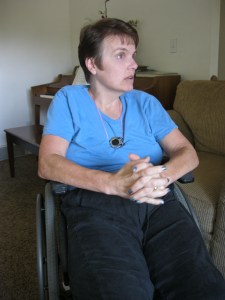
This is a picture I took of my mom a couple of years before she passed away. At this point my mom was struggling with everything I just described. It was difficult to understand her slurred speech, but as her daughter I could still understand her. She spent a lot of time in bed, and many times I would sit next to her to talk with her. Yes, she had an extremely large dose of hard and discouraging times. I remember once she told me that at her funeral she wanted a disco ball and dancing. She wanted everyone to celebrate with a grand party because she was finally freed from her crippled body! You should know that my mom had quite the sense of humor. As I watched my mom live through it all, I was so amazed and awed by her strength. Her gratitude was inspiring. When she was discouraged, which was often, she would count her blessings. She was truly grateful for the few things she could still do. She had such great faith, hope and love. I know the Lord was with her. I love you mom. Happy Mothers Day!
I want to end this post with a video of my cousin Callie. It gives you a good sense of how the disease affected her. She passed away a year and a half after the filming of this video. Just a little info about Callie. She is THE sweetest, most pure, and most fun person to be around that I have ever met. I loved all the time that I spent with her. I am sure that everyone who knew Callie will agree that the time they spent with her made them a better person. Memories of her make me smile real big. I love you Callie!
Next Post: Grandpa Paul Canfield


Leave a Reply